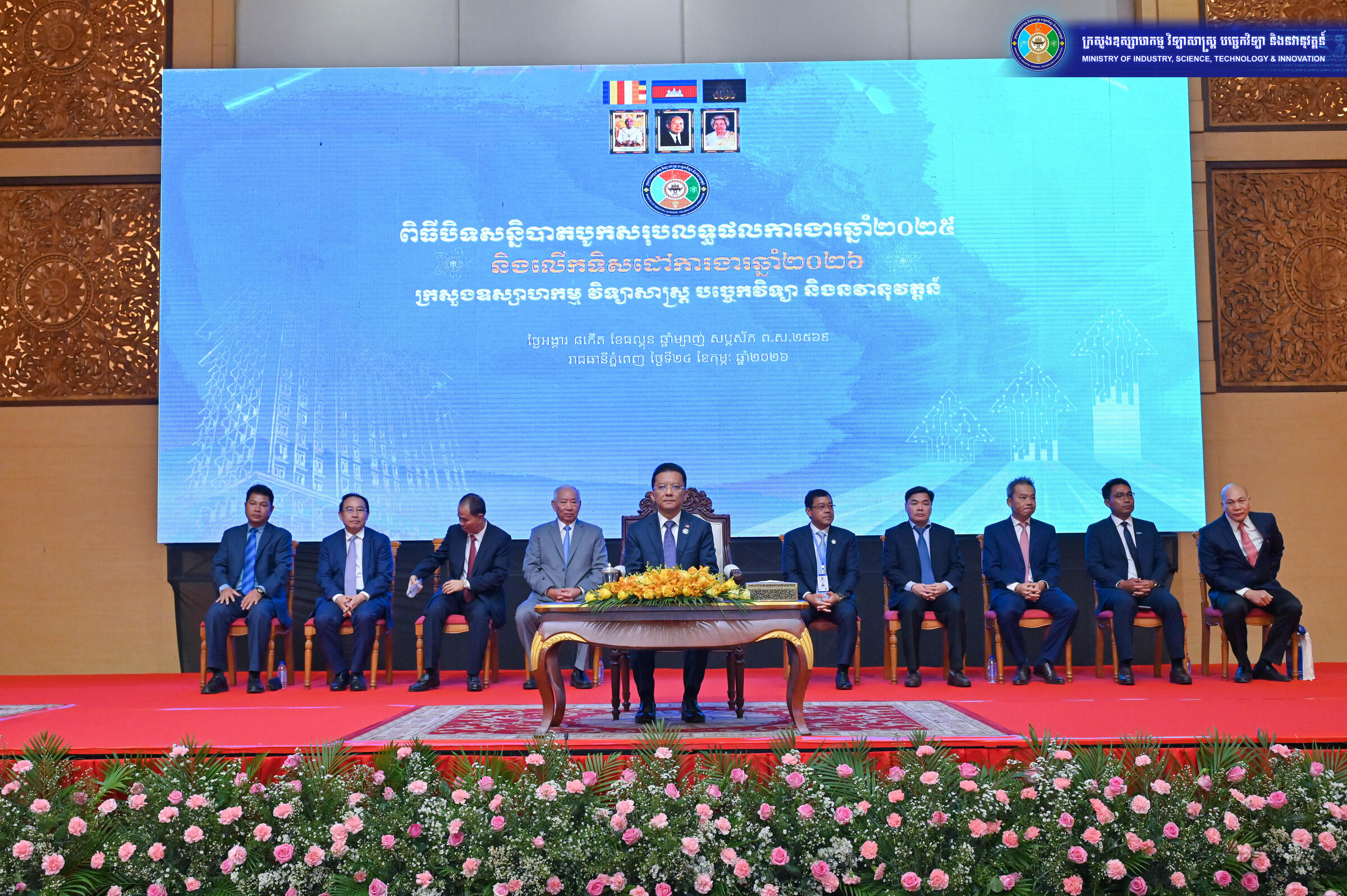
Phnom Penh, February 24, 2026 — The Ministry of Industry, Science, Technology & Innovation (MISTI) concluded its 2025 Review & 2026 Planning Conference with clear direction to strengthen national institutions, enhance domestic production, and accelerate reforms to support Cambodia’s long-term economic resilience and competitiveness.
Closing the one-and-a-half-day Conference, H.E. Hem Vanndy, Minister of Industry, Science, Technology & Innovation, underscored that 2025 marked significant progress across MISTI’s core sectors, including industry, SMEs, water supply, national quality infrastructure (NQI), science, technology and innovation (STI), and informal economy development.
Cambodia’s industrial base continued to expand, with 3,083 large factories operating nationwide and employing over 1.26 million workers, more than 71 percent of whom are women. Clean water coverage also grew substantially, reaching 1,571,976 connections in 2025 — an increase of more than 131,000 new connections — supported by an expanded distribution network of 40,565 kilometers and total production of 556 million cubic meters.
Informal economy development advanced steadily, with approximately 270,000 individuals registered through the government’s digital platform by the end of 2025, while benefits have continuously been developed, reflecting efforts to build an economic system that leaves no-one behind.
The Minister highlighted progress in strengthening Cambodia’s NQI, noting that in 2025, the country became a full member of the International Organization for Standardization (ISO) after 35 years, an Associate Member of the International Electrotechnical Commission (IEC), and a Focal Point for CODEX Alimentarius. A total of 129 ASEAN Harmonized Standards and 81 Cambodian standards were adopted to enhance export readiness and compliance.
Reflecting on current regional uncertainties, he stressed the importance of strengthening domestic production and supply chain resilience, stating, “A country that does not produce cannot fully protect its resilience. The national movement to support Cambodian products is not merely emotional — it is a strategic opportunity to accelerate domestic production, strengthen local supply chains, and ensure that local businesses can compete in both local and global markets.”
Looking ahead to 2026, MISTI will focus on preparing Cambodia for a new development phase marked by reduced trade preferences, stricter compliance requirements, greater emphasis on domestic content, and rising ESG expectations.
Priorities include reinforcing the National Quality Infrastructure, accelerating digital transformation for SMEs, expanding clean water access, strengthening science, technology and innovation, modernizing public service delivery, and enhancing institutional effectiveness.
“The world is increasingly uncertain. We must transform challenges into opportunities and continue building strong institutions that deliver results for the nation and the people,” Minister Vanndy added.
The Conference concluded with a firm commitment to advance reforms, reinforce partnerships, and strengthen national institutions to safeguard Cambodia’s economic resilience and sustain long-term growth in an increasingly uncertain global environment.
By: The Ministry of Industry, Science, Technology & Innovation (MISTI)